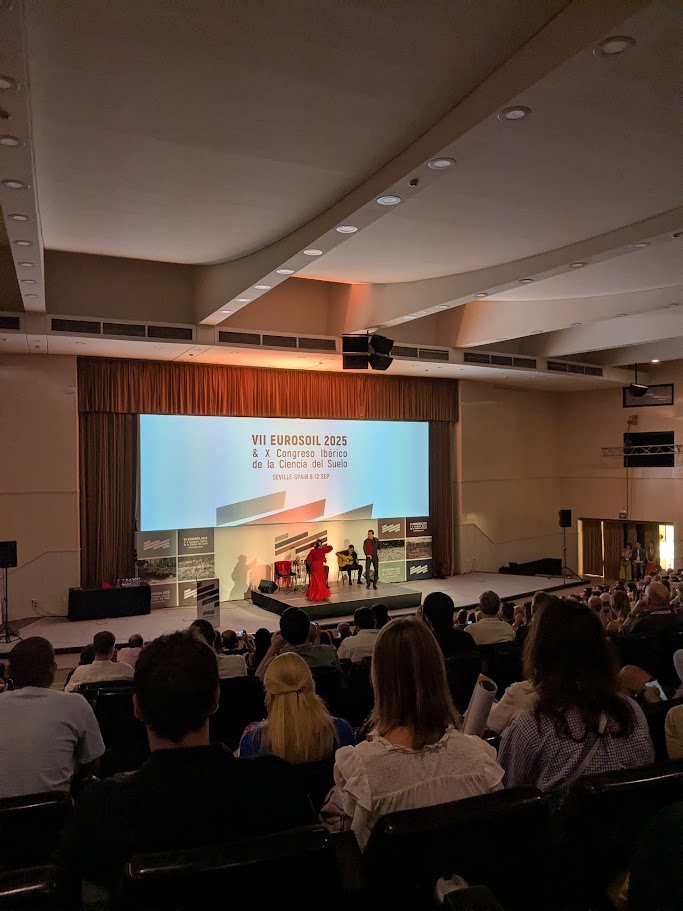
Last September, I had the opportunity to attend EUROSOIL 2025 together with the Environmental Soil Science, Chemistry and Agricultural Technology Team of the Technical University of Cartagena (UPCT). This congress is one of the most relevant international events in the field of soil science, bringing together researchers, practitioners and policy makers to discuss advances in soil functioning, management and restoration.
During the event, I presented two contributions:
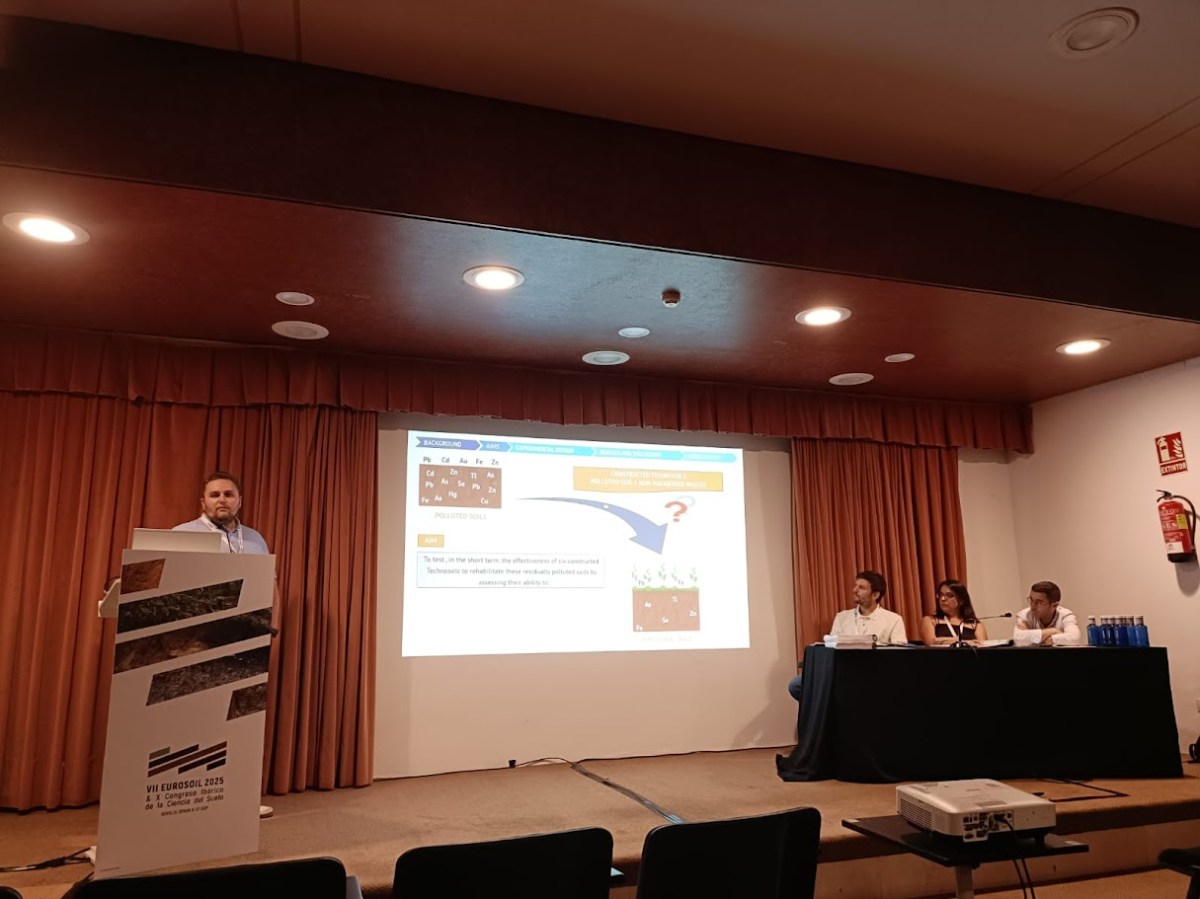
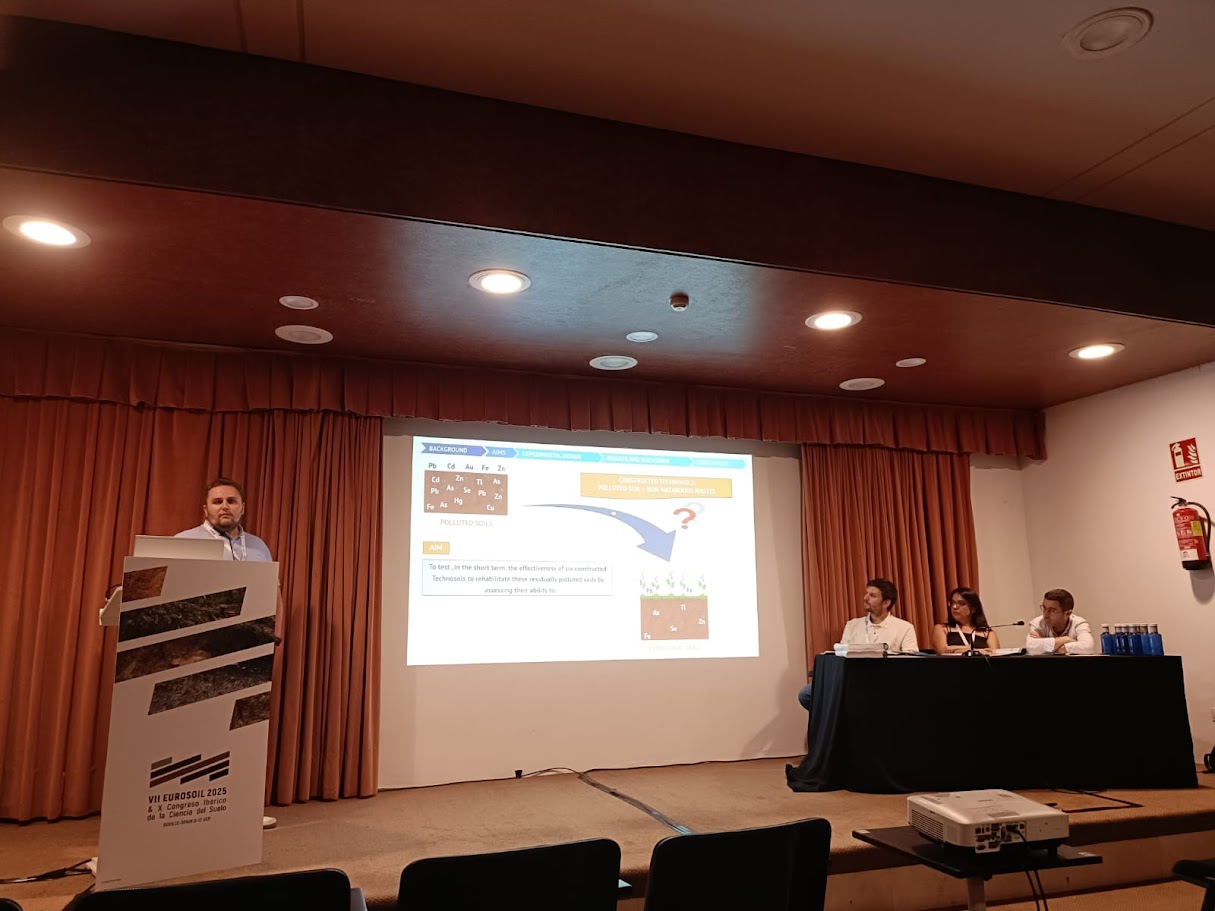
- an oral communication derived from my doctoral research on constructed Technosols and phytomanagement.
- a poster framed within the Horizon Europe project SOILPROM, focused on modelling and assessing metal transport in the Cartagena–La Unión mining district; and
1. Assessing metal transport in the mining district of La Unión–Sierra de Cartagena (SE Spain): a use-case of the SOILPROM project
(Poster presentation)
This contribution forms part of the Spanish use-case of the SOILPROM project, which aims to develop integrated models to better understand pollutant transport and fate in soils across Europe. Our work focuses on the El Beal wadi, an ephemeral stream that drains the historical mining area and acts as a major pathway for the dispersion of metal(loid)s such as Pb, Zn, Cd and As.
The poster presents the methodology we are implementing to quantify hydrological and wind-driven metal transport, combining:
- Field monitoring of sediment retention using erosion nails and drone-based photogrammetry,
- Post-storm sediment sampling and characterization,
- Installation of dust collectors to capture airborne particles during the driest months,
- Numerical modelling with OpenLISEM (water erosion) and MicroHH (wind erosion).
This integrated approach will provide essential information for identifying critical transport zones and supporting future remediation strategies in semiarid mining environments.
2. Constructed Technosols enhance barley growth and reduce metal uptake in polluted soils
(Oral communication)
The second contribution, linked to my doctoral thesis at the University of Granada, explored the potential of constructed Technosols—engineered mixtures of polluted soil and valorised wastes—to support the growth of barley (Hordeum vulgare L.) as a phytomanagement strategy in soils still affected by the Aznalcóllar mining spill 25 years after the accident.
Six Technosols were tested under controlled conditions, each combining polluted soil with different organic and inorganic waste materials. The results demonstrated that these Technosols:
- Substantially improved plant growth (biomass, length, chlorophyll content),
- Reduced metal uptake in shoots, favouring phytostabilisation,
- Restored part of the soil’s functional capacity, even under persistent contamination.
These findings reinforce the potential of Technosols as a cost-effective circular-economy tool for restoring degraded mining soils.
A rewarding scientific and collaborative experience
Eurosoil 2025 was an excellent opportunity to share ongoing work, discuss methodological challenges, and strengthen collaborations with colleagues across Europe. Presenting both my current postdoctoral research on SOILPROM and a complementary study from my PhD allowed me to highlight the continuity of my work on soil pollution, remediation and sustainable land management.
I am grateful to the UPCT Soil Team and the UGR Soil Team for the collaborative effort behind these contributions and to the organising committee for an inspiring congress.


 Antonio Aguilar-Garrido